
ups-selection-guide
UPS Backup Power Planning for Small Data Centers
A practical guide for planning UPS capacity, runtime, battery cabinets and upgrade paths for small data centers, server rooms and IT infrastructure projects.
Why small data centers need practical UPS planning
A small data center or server room may not need a large data center power system, but it still needs careful UPS planning. The UPS must match the real IT load, input and output voltage, backup time requirement and future upgrade plan.
For regional IT service providers and server room service companies, good UPS planning can reduce project risk and create clearer quotation requirements.
Start with the real load
UPS capacity should not be selected only from the number of racks or device nameplates. Before choosing a UPS, collect:
- Real load in kW or kVA
- Number of server racks or equipment cabinets
- Critical equipment list
- Expected load growth
- Single phase or three phase power requirement
- Input and output voltage
If the load is still small, a single phase online UPS may be enough. If the project is growing or already needs three phase power, a three phase online UPS should be reviewed.
Decide the required backup time
Backup time changes the battery configuration and total project cost. A 10-minute bridge time for generator startup is very different from a 1-hour or 2-hour long-runtime project.
Clarify:
- Required runtime at real load
- Whether a generator is available
- Whether all loads or only critical loads need backup
- Site temperature and battery room condition
- Space available for battery cabinets
Choose the UPS topology
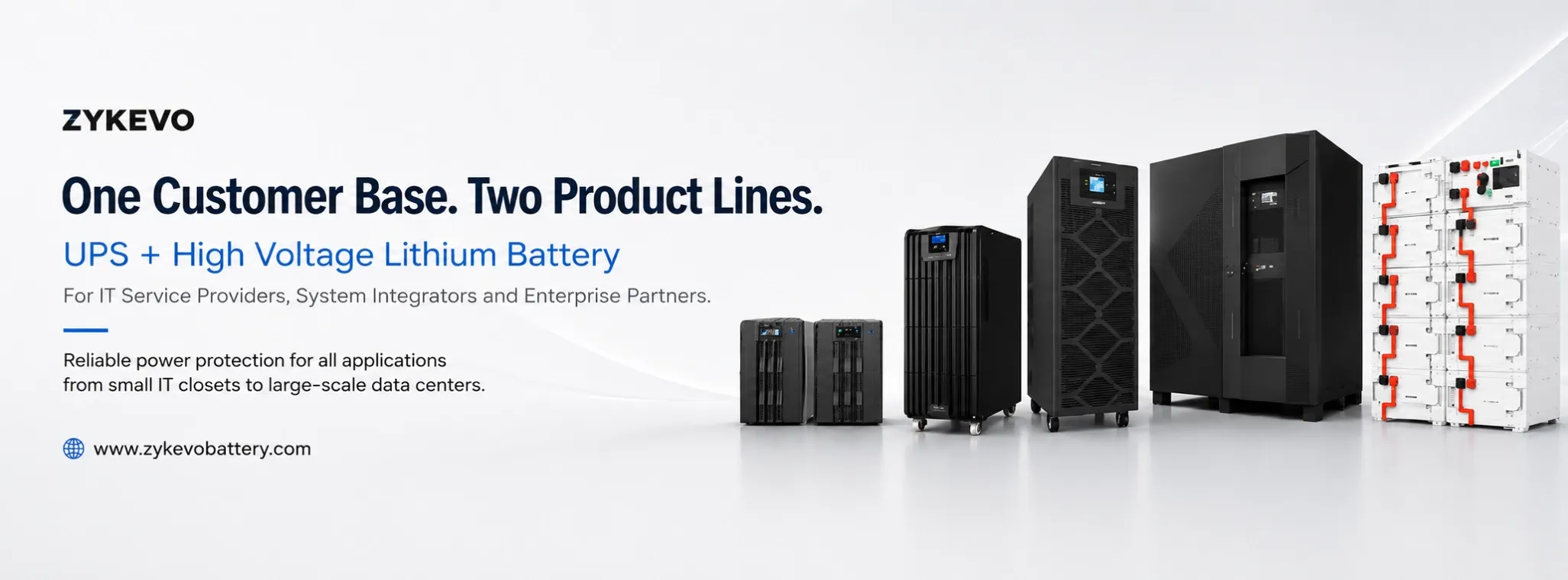
For small server rooms, ATLAS Series single phase online UPS can be considered for 1kVA to 10kVA applications such as server racks, IT rooms and network cabinets.
For larger server rooms and small data centers, TITAN Series three phase high frequency online UPS can be considered for 10kVA to 200kVA applications.
For weak grid, industrial load or transformer-based long-runtime projects, FORTRESS Series low frequency UPS may be more suitable.
Plan the battery system early
Battery planning should happen before the quotation is finalized. The project may need:
- Internal UPS battery for short runtime
- External battery cabinet for longer runtime
- Lead-acid battery replacement for an existing UPS
- High-voltage lithium battery system for selected compatible UPS projects
ZYKEVO high-voltage lithium battery systems are UPS companion battery solutions. They should be matched to the UPS DC voltage window, charger specification and real backup time requirement.
Consider maintenance and future replacement
Small data center operators often care about uptime, maintenance access and predictable replacement cycles. When planning the UPS system, review:
- Battery service access
- Bypass and maintenance plan
- Spare parts availability
- Site ventilation and temperature
- Monitoring and communication needs
- Whether the customer may upgrade load in the future
Information to send for project review
To review a small data center UPS project, send:
- UPS capacity target or current load
- Input and output voltage
- Single phase or three phase requirement
- Required backup time
- Existing UPS model, if this is an upgrade
- Battery preference and site space
- Generator use and utility power condition
- Any OEM or branding requirement
Common mistakes to avoid
- Selecting UPS capacity without real load data
- Ignoring future load growth
- Planning battery cabinets after the UPS has already been selected
- Promising lithium retrofit without compatibility review
- Treating a small data center like a large data center EPC project
Need help planning a small data center UPS project?